

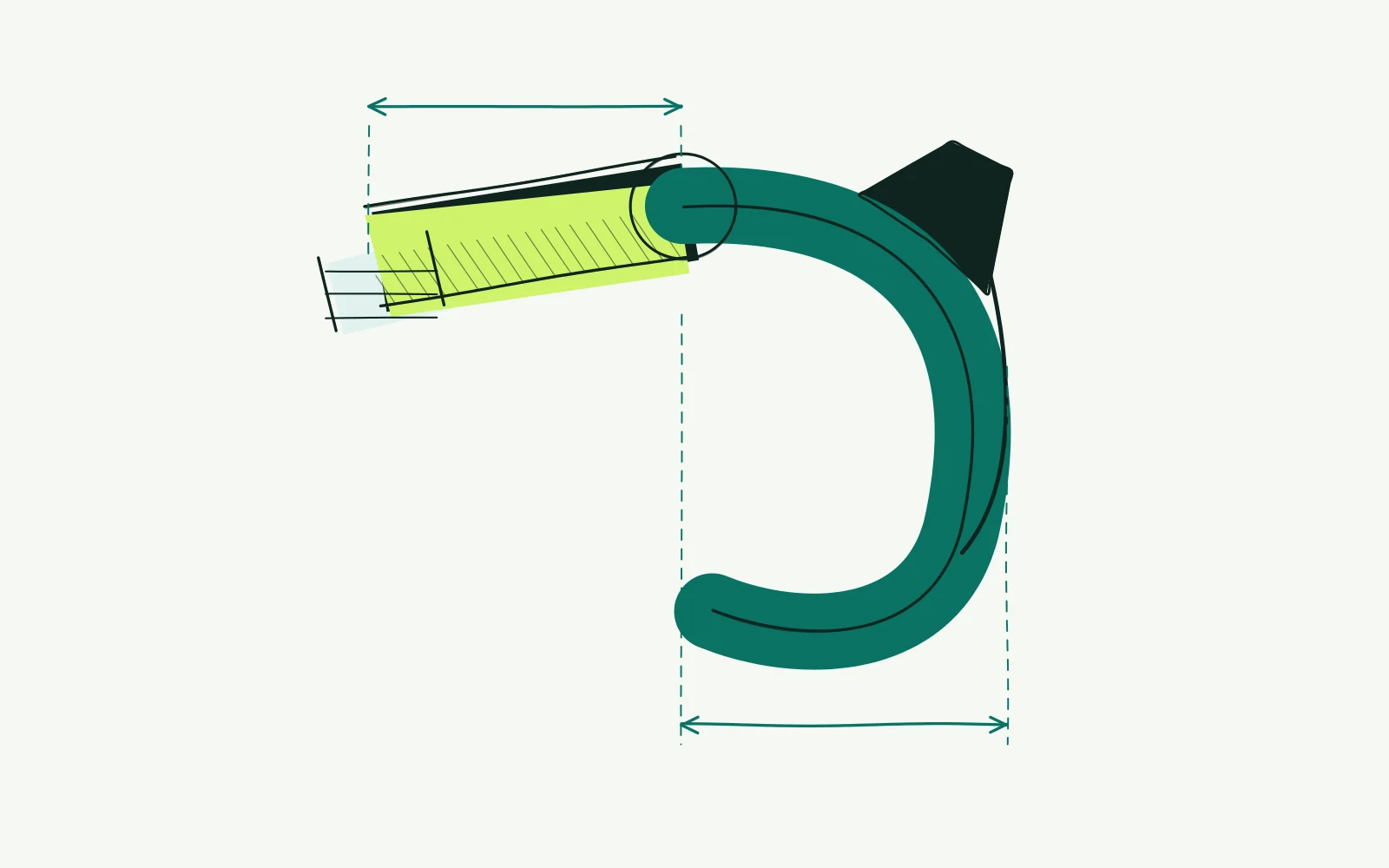
The problem: choosing stem length
You feel stretched out when riding on the hoods. Or you feel so compact that moving becomes awkward. Someone suggests a shorter stem, but you do not know your current length. Perhaps you try moving the saddle forwards instead.
That seems a simple way to bring the bars closer. At the same time, it changes your seating and relationship to the pedals. Your original question then becomes harder to assess. Record which contact point needs attention before moving anything.
Describing when the problem occurs helps. Do the bars feel distant immediately or only when you become tired? Does it happen on the hoods, tops or drops? Can you operate every brake lever easily?
Those differences guide a comparison. An isolated stem measurement cannot explain why your position feels uncomfortable.
Background: frame reach is not hand reach
Frame reach is a horizontal measurement from the bottom bracket to the top of the head tube. The stem positions the bars further forwards from that area and usually at a different height too. Its angle and available spacers therefore matter. Comparing the length marking alone does not describe the complete change.
The bar itself also has shape and reach. Brake hoods add another contact surface. Different bars can move your hands while retaining the same stem. Equal distance to the bar centre does not necessarily mean equal hand position either.
Saddle position forms the other part of the comparison. If you measure from the nose, a different saddle changes that reference too. Include every measuring point in your notes. Fixed coordinates relative to the bottom bracket are more useful for transferring a position precisely.
Ask a fitter for help if you cannot measure them reliably yourself.
A longer or shorter stem also changes the arrangement through which you steer. The desired outcome is more than relaxed shoulders in a photograph. You must be able to brake, look behind and move safely. Assess the bike during easy riding, not only while stationary.
Not every combination is permitted. Integrated bars, cable routing and steerer length can restrict the options. Check instructions before considering extra spacers or a different angle. Online advice cannot replace that technical check.
Do not cut components simply to try an initial position.
How to approach it with bike fitting
-
Record the question behind the measurement: Write when you reach, lock your elbows or slide forwards. Distinguish distance from height. Also record which hand position remains comfortable.
Have pain or lost sensation assessed; a shorter stem is not a diagnosis or a guaranteed solution to either.
-
Measure the existing stem: First look for its length marking. Otherwise measure from the centre of the steerer clamp to the bar clamp centre.
Record millimetres and the marked angle. Do not measure total outer length including protruding bolts. Photograph the stem and spacers from the side so you can reconstruct the setup later.
-
Record your hand position: Use a tape measure and spirit level with fixed reference points on the saddle and hood. Also record bar height. Repeat measurements with the same points and bike orientation.
The bike fit calculator helps organise body measurements and your starting position. Compare its result with your actual contact points.
-
Choose a change that addresses the question: To shorten reach, compare a shorter stem while keeping the remaining build equivalent. If height is the main issue, first check permitted spacer and stem options. Do not simultaneously move the saddle to address the same question.
Record the actual step in millimetres and degrees; available increments and permitted combinations differ between systems.
-
Check installation and test calmly: Follow the correct torque settings and check cable room and free steering movement. Begin with braking and turns in a safe, open area. Then compare two to three easy rides while you remain symptom-free.
Keep clothing, route and effort consistent. Stop for new pain or reduced control and return to the recorded safe starting setup.
-
Get help with persistent problems: A fitter can assess whether frame, saddle position and bars work together. If position-related pain remains after three to four careful adjustments, consult a fitter and, where appropriate, a clinician. Seek earlier medical assessment for pain at rest or at night, swelling, radiating tingling or lost sensation.
Do not make the bike progressively more extreme to temporarily avoid a symptom you do not understand.
Further reading
- Bike size and geometry helps identify which differences come from the frame and which come from fitted components.
- Numb hands cycling: where should you start? discusses hand pressure and wrist position when reach is not your only issue.
- Saddle pain cycling: support, pressure and friction explains why seating should not simply shift to reach the bars.
- Race versus endurance geometry helps compare the starting positions of different bikes.
- The bike fit calculator provides a starting point for assessing the whole position.
Frequently asked questions
Can I move the saddle forwards to shorten reach?
That changes the distance, but also your seating relative to the pedals. Do not use it as an automatic solution for distant bars. Establish where you sit well on the saddle first. Then assess whether the handlebar side needs a focused adjustment rather than changing both ends together.
Is a shorter stem always easier on my shoulders?
No. Bar height, hand position and support on the saddle affect how your upper body rests too. A shorter stem may help when reach is the issue, but it needs safe testing. After installation, assess steering and control access as well as how the position feels while stationary.
Why does my stem measure differently from its marking?
You may be measuring outside edges instead of centre to centre. The intended length runs between the centres of the two clamps. Its angle can make a horizontal tape measurement confusing. Check the manufacturer's drawing when uncertain, especially with integrated components that have an unusual shape.
Can I fit the same stem to any bike?
No. Clamp diameters, steerer, cable routing and permitted combinations need to match. Available lengths and angles also differ between systems. Have a mechanic check the combination if you are unsure.
Suitable reach on paper does not make a mechanically incompatible installation usable or safe to ride.
This guide covers one part of your riding position. Read how bike fitting connects your measurements and bike setup.
Record your current reach and assess the next step within your complete riding position.
Calculate your bike fit