

The problem: choosing crank length
Your new bike has different cranks from your previous one. You are unsure whether that difference matters. Perhaps the top of the pedal stroke feels cramped. Or you hear that shorter cranks automatically offer more comfort.
It can be tempting to order another set immediately.
First ask what you want to improve. Is it movement room, pedal clearance or a calculated size that differs? Record when you notice something and in which position. A symptom during a hard climb differs from feeling cramped in a low position.
You can also be curious about another length without having symptoms. There is no need to rush. Record your current measurement and setup before comparing components. That prevents an expensive purchase from introducing several unknown changes together.
This guide helps you prepare the discussion and any eventual test.
Background: the pedal circle changes
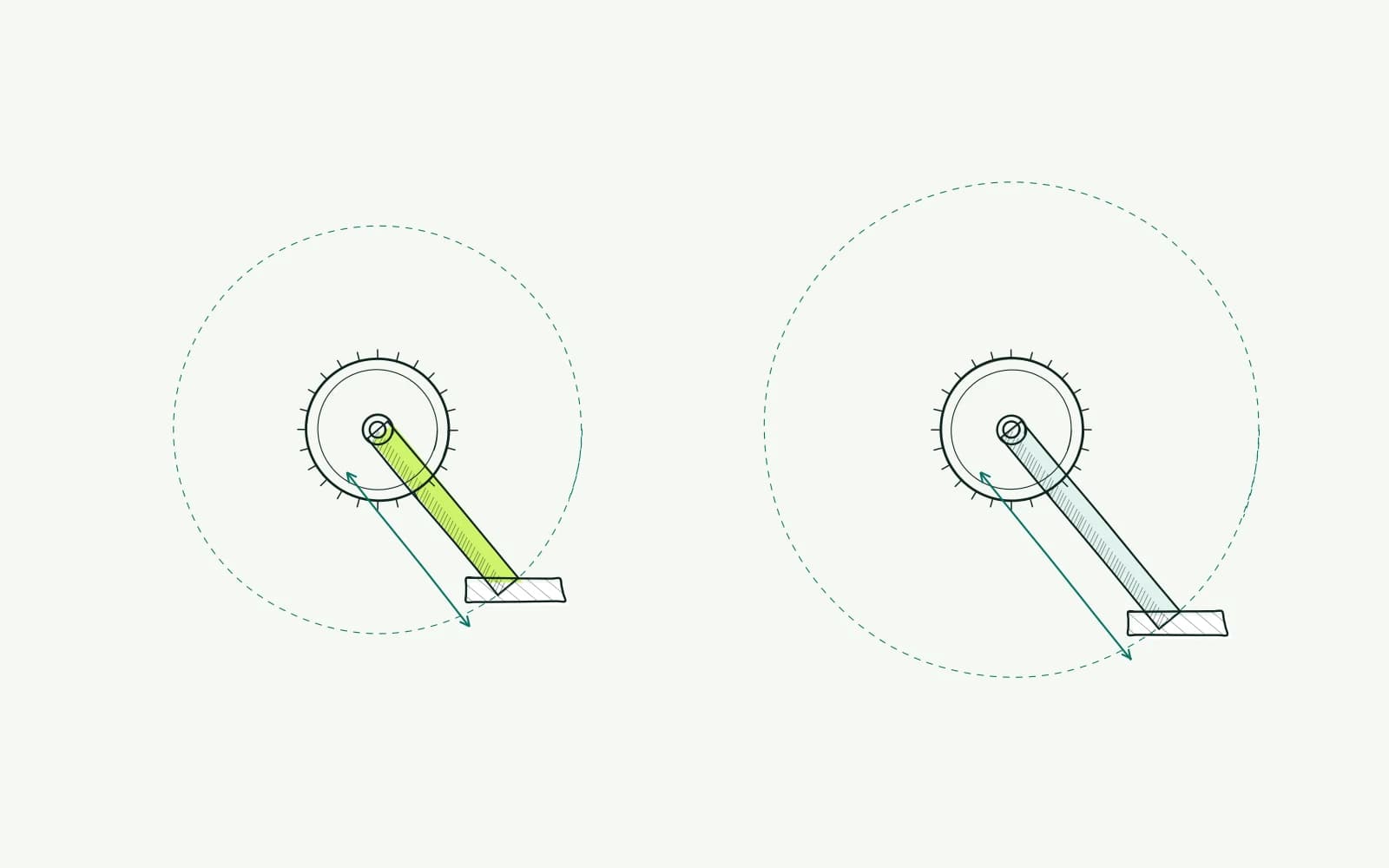
Crank length is the distance from the centre of the bottom bracket to the centre of the pedal axle. You do not measure to the end of the crank arm. The measurement is often marked on its inside. Check both sides if you are unsure about the components' history.
A shorter arm describes a smaller circle. With the saddle unchanged, this alters the distance to the pedal along its path. The pedal reaches less high at the top and less low at the bottom. Crank length and saddle height therefore need consideration together.
A change can also affect the perceived saddle-to-bar relationship when saddle height is adjusted.
Shimano describes shorter cranks as one possible way to reduce the hip flexion required in a low position. That provides a reason for focused testing, not a guarantee that a particular symptom will disappear. The same source describes testing in 2.5 mm increments on a fitting bike; available lengths differ between crank models.
Body measurements help establish a starting point. They cannot describe how you move or which position you sustain comfortably. Shoes, pedals and intended riding also belong in the assessment. A result with a precise number remains advice with limitations.
The replacement also needs to fit mechanically. Consider the bottom bracket, chainline, chainrings and any power meter. Length alone cannot establish compatibility. Check combinations with the manufacturer or mechanic before buying.
A suitable measurement on paper does not guarantee a suitable installation.
How to approach it with bike fitting
-
Read your existing measurement: Find the length marking on the inside of the crank arm. If it is unreadable, measure centre to centre with an accurate ruler. Record millimetres, brand and model.
Do not measure along the sloping outer edge. Take a photograph so a fitter or mechanic knows which component you mean.
-
Measure your inseam again: Follow the measurement instructions in the crank length calculator. Use the same position when repeating the measurement and ask for help if reading it is difficult.
Also record the type of bike involved. A result that differs from your current length invites comparison, not immediate replacement.
-
Define what you will compare: Describe your aim: room at the top, comfortable pedalling or position under load. Record saddle height, setback and handlebar position using fixed reference points. Keep symptom notes separately.
Have existing pain assessed before treating a crank change as a remedy. A calculator cannot establish its cause.
-
Plan one controlled comparison: Discuss an available alternative length with a fitter, preferably on an adjustable fitting bike. A 2.5 mm step is a described testing option, not a mandatory correction for every rider.
Have the corresponding saddle position checked too. Record all necessary corrections as one test setup so the comparison remains clear.
-
Check mechanics and riding feel: Have components installed according to the correct manual and check any power meter setting. Then compare two to three easy, similar rides while you remain symptom-free. Keep shoes, route and effort consistent.
Record improvements and new problems alike. If things worsen, stop and discuss returning to the original safe setup.
-
Recognise the limit of testing yourself: Ask a fitter for help when you cannot assess the change reliably. Pain at rest or during the night, swelling, radiating tingling or lost sensation needs medical assessment. If position-related pain persists after three to four careful adjustments, seek guidance instead of repeatedly buying components.
Do not wait through those tests when sensation is reduced.
Further reading
- Bike size and geometry helps distinguish the frame's dimensions from the components through which you move.
- Cycling shoe and cleat fit discusses the other end of the crank: your connection to the pedal.
- Bike fitting science explains how to use calculated values without treating them as individual certainty.
- Online bike fit limitations clarifies when a supervised comparison offers more than repeating a calculation.
- The crank length calculator provides a starting point you can compare with the length currently fitted to your bike.
Frequently asked questions
Are shorter cranks better for everyone?
No. That conclusion does not follow from a smaller pedal circle. Your goal, current position and experience remain relevant. A focused test may help, but a trend does not oblige you to replace components.
If you ride comfortably, begin with a clear question before spending money.
Should my saddle rise with a shorter crank?
The distance to the pedal changes, so saddle position needs checking again. That does not mean a single calculation defines your complete new position. Have the intended leg movement and seating assessed together. Record the old and new values so the comparison remains understandable later.
Can I copy a friend's crank length?
Their measurement does not explain why it would suit you. Even at the same height, body proportions, position and aims can differ. Use your own measurements and current bike as the starting point. Only compare components that are mechanically compatible with your bike and can be installed safely.
Do longer cranks automatically give me more power?
More length does not automatically mean more useful power. You also change the pedal path and how you pedal. Do not treat a purchase as guaranteed performance improvement. Comparing performance requires a repeatable test alongside consideration of comfort and position, rather than a length measurement alone.
This guide covers one part of your riding position. Read how bike fitting connects your measurements and bike setup.
Compare a calculated starting point with the crank length currently fitted to your bike.
Calculate your crank length