

The problem: comparing cycling power and speed
You are producing the same power as last week but travelling more slowly. Your cycling computer shows familiar wattages. Yet every kilometre seems to take longer. You might wonder whether something is wrong with your bike setup.
The opposite happens too. On another road, a higher speed comes easily. That feels like progress, but you do not know how much the conditions contribute. Comparing only the averages of both rides gives no clear answer.
A ride also includes corners, junctions and times when you coast. Average power and average speed summarise those different situations. They do not describe one steady stretch of road. A calculator cannot supply the missing history of that ride.
You therefore need to understand which comparisons are meaningful. This guide helps you separate resistance, position and inputs. It can prevent repeated harder efforts or adjustments made simply to achieve a theoretical speed. Start with conditions that you can actually record.
Background: three contributions to required power
Our model adds power for climbing, rolling and aerodynamic resistance. It then accounts for drivetrain losses. It uses body mass and bike mass together. You also select gradient, surface and bike type for the corresponding assumptions in the calculation.
Climbing includes the effect of gravity. Greater total mass requires more power at the same gradient and speed in this model. For rolling, the calculation uses a fixed resistance value per surface. This does not measure your particular tyres, pressure or road texture.
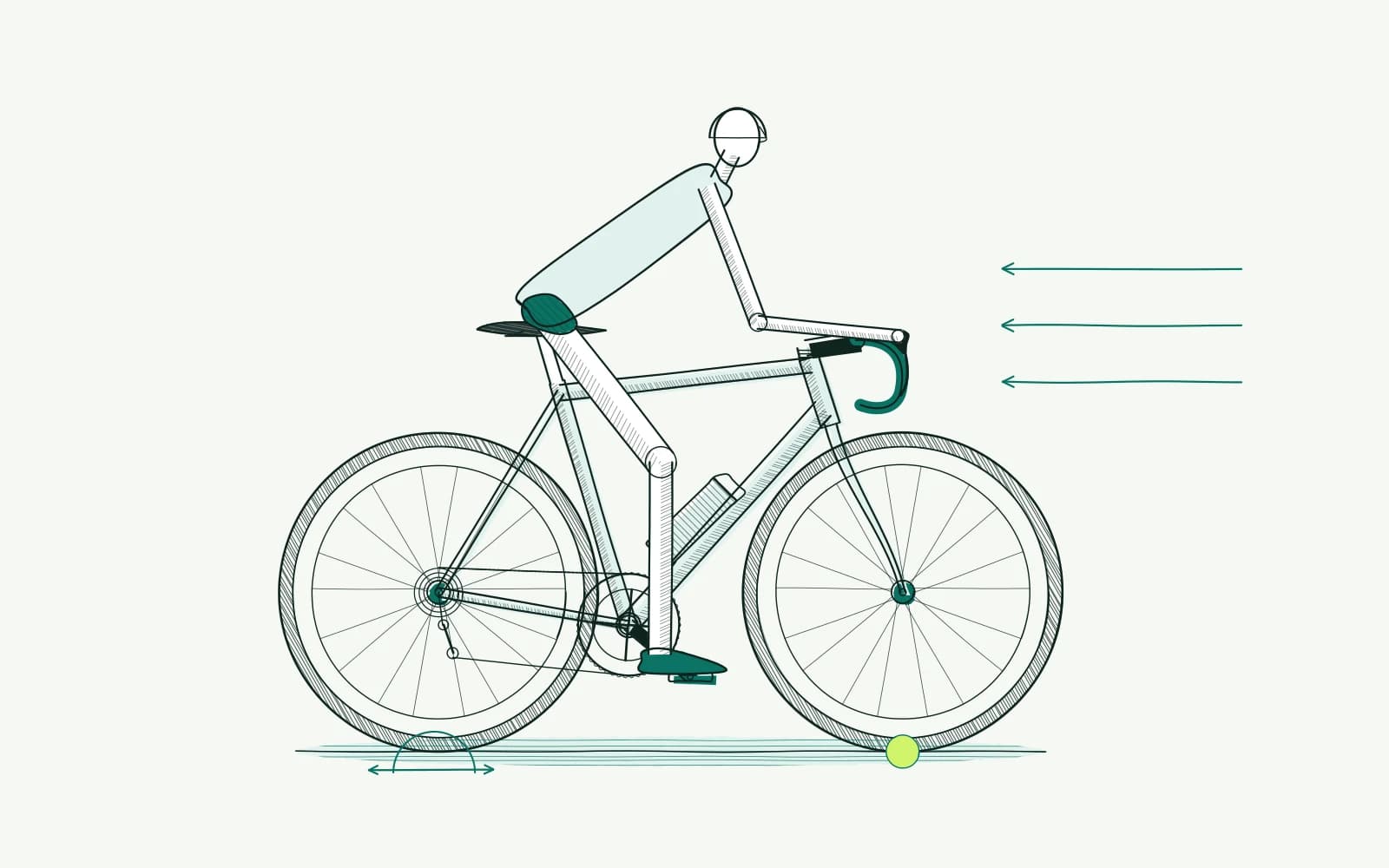
For aerodynamic resistance, the model uses a fixed value per bike type. It does not measure body shape or position. In the formula, aerodynamic power grows with the cube of speed. This applies within the assumptions, including a situation without separately modelled wind.
You therefore cannot conclude that twice the power always produces twice the speed. The contributions change with speed and gradient. Headwinds and tailwinds change the real situation but are absent as separate inputs. Riding beside others or receiving shelter is not personally calculated either.
The calculator can estimate required power from speed. In reverse, it searches for a speed matching the entered power. That search has limits. A calculation-range warning does not prove that the displayed boundary will become your actual speed.
Meanwhile, gearing determines the relationship between cadence and speed. A bigger gear does not supply extra power by itself. Our gearing formula links wheel circumference and tooth ratio to distance travelled per pedal revolution. Keep that mechanical relationship separate from the resistance you must overcome.
How to approach it: compare the same situation first
-
Choose a clear stretch of road: Find a familiar section where steady riding is safe. Avoid a comparison based on a whole ride containing many stops. Record wind direction, surface, gradient and whether you rode alone.
Keep your speed safe and watch traffic. The aim is to understand your measurements, not to stare continually at a screen while riding.
-
Check your inputs: Record body mass and bike mass with their units. Choose a bike type and surface that approximate your situation. Do not select a gradient because it produces a nicer result; use available route data and acknowledge uncertainty.
The power and speed calculator helps you record the combination. Remember that fixed resistance values do not replace personal measurements.
-
Change one assumption: Keep every other field unchanged and alter only gradient, for example. Examine the effect on power or speed. Then compare another surface if it reflects the roads you actually use.
This shows which part of your question the model can answer. You cannot reliably imitate wind by arbitrarily selecting a different bike type.
-
Compare a usable position: Take a side photograph and record where your hands hold the bars. Check that you can look ahead and reach the brakes safely from that position. Also note whether you can maintain it gently without repeatedly searching for support.
Explore your usual hand positions before moving components. Choose a position with reliable support and control for the comparison. If that requires a different handlebar setup, keep your original measurements and have a mechanic check manufacturer limits, cable length and torque specifications.
-
Compare two to three easy rides: Test only one setup change at a time and keep your route familiar. Record comfort and control alongside power and speed. Note changed wind even when that makes the comparison less tidy.
Restore your recorded starting position if things worsen. Avoid drawing aerodynamic conclusions from one fast ride; the model has not measured your position.
-
Stop chasing the result: A theoretical speed is not a safe minimum. Stop for pain or loss of control. Ask a fitter to assess a recurring position problem instead of repeatedly adjusting further.
Pain at rest or at night, swelling or radiating tingling need medical assessment. Seek help too if pain remains after three to four careful adjustments. A calculator cannot explain those warning signs.
Further reading
- What is cycling FTP? helps you understand the power reference you are using before comparing a predicted speed.
- Cycling climb time: plan your effort shows how gradient and estimated power combine to affect your expected uphill time.
- Triathlon bike fit: support in aero discusses support when you consider a different position and want to assess it safely.
- Road bike fit: your three contact points helps you examine control and comfort in your current position systematically.
- The power and speed calculator compares individual assumptions without making its output a promised road speed.
Frequently asked questions
Can I enter a headwind in the calculator?
No, this calculator has no separate wind input. Record wind with your ride notes and treat differences from the calculation as uncertainty. Do not simply choose a heavier surface to replace a headwind. That changes a different assumption without actually modelling the wind.
Will a bigger gear make me faster?
At the same cadence, a bigger gear changes calculated speed. That does not mean you can sustain that combination. Required effort still depends on resistance and gradient. Use gearing to pedal appropriately, rather than treating it as proof that extra power is available.
Why does my ride average differ from the result?
The calculation describes a steady situation. Your ride probably contains changing speeds, braking and sections without pedalling. That ride average is not the same input as one constant section. Compare conditions carefully before attributing any difference between the numbers to your bicycle.
Does a faster ride prove my position is better?
No, wind and route may also have changed. First assess whether you steer and brake safely and remain comfortable. Keep your previous measurements and repeat gently. An individual assessment of aerodynamic resistance requires more than a speed figure from this calculator alone.
This guide covers one part of your riding position. Read how bike fitting connects your measurements and bike setup.
Compare power and speed using traceable inputs and check the result against your own ride notes.
Compare power and speed